brick · vernacular · spatial comfort · tropical architecture · clinker · passive ventilation · craft tradition · monolithic · industrial-domestic transition · biodynamic
I am an architectural photographer. I trained as an architect at the University of Seville, and one could say the tools of my craft are limited to the world of representation, the world of appearance.
Because of my background as an architect, I know that the spatial experience transcends its representation: the perception of a space depends on the subjectivity not only of our sight, but also of temperature, humidity, acoustic and dynamic qualities, and other intangibles that turn it into a complete experience when all these factors are perceived by our body in unison.
As a photographer I sometimes feel powerless to convey more fully the comfort I perceive when I am in certain spaces. I limit myself to establishing relationships between photographs so that, together, they construct a brief narrative of a very complex idea we call ‘architectural project’, knowing that no single photograph will ever fully represent that comfort, that spatial experience.
Comfort is hard to define, though we can agree it is made of more or less subjective parameters acting on our senses. The light in a workspace, the temperature in a waiting room, the proportion of a stair tread, or any draught of air in a domestic space — these are partial qualities of comfort. If we extend the concept further, we must admit that it changes with time, with location, and with cultural context.
But I told you my world is the world of appearances, and in this world there are materials and spaces built with them that lend themselves to being represented with attributes beyond the merely visible. The most special of all these materials, for me, is ceramic brick.
I find that the spaces I have photographed built with brick are more comfortable in their representation than those built with more universal materials such as concrete or glass. The latter usually remain indifferent to the latitude in which they are used, but brick especially has a vernacular condition that adapts techniques and forms to each place where it appears, making it remarkably versatile in its applications.
I have also encountered brick in nearly every country where I have worked, in very diverse contexts and typologies. In more than forty countries, from the Tropic of Capricorn (Chile and Zambia) to countries closer to the equator (Brazil and Sri Lanka), of course those above the Tropic of Cancer where I mostly work, and as far north as countries near the Arctic Circle (Denmark and Sweden).
In all of them, architecture must respond to a dominant condition: humidity, excessive heat, or rain. Some allow technologically more recent responses, but the constant is the appearance of brick, with greater or lesser prominence, proposing answers to the environment in order to generate comfort. This holds true both in domestic architecture and in public buildings, fulfilling specific functions without structural display or excessive aesthetic or iconographic burden.
House for an artist in Pittugala — Palinda Kannangara
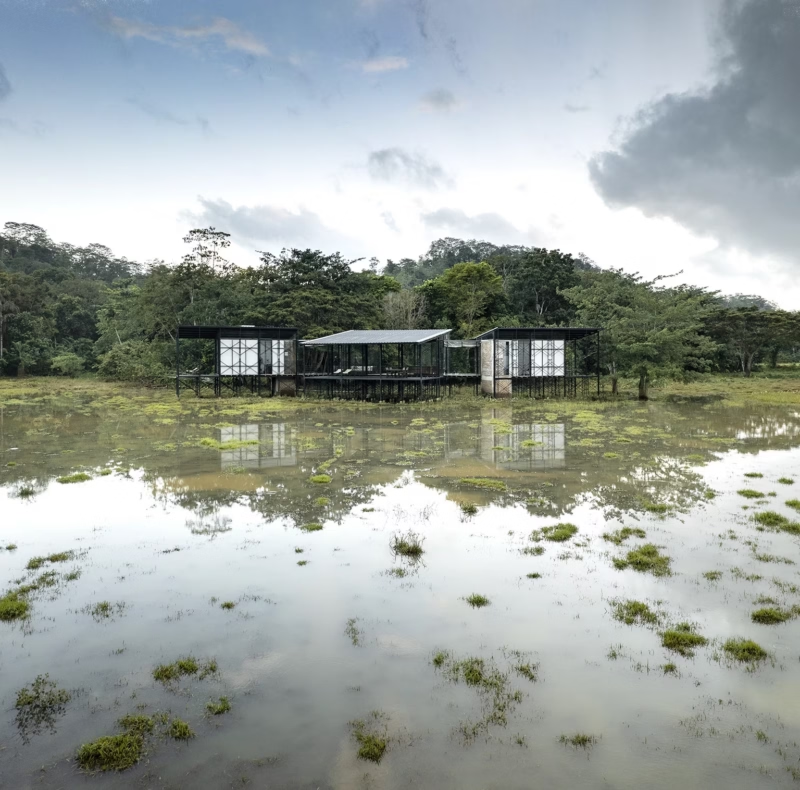
To illustrate these ideas — drawn more from accumulated experience than from academic study — I would like to begin with a domestic project by Sri Lankan architect Palinda Kannangara. With a budget of approximately €55,000 (10 million rupees), and given the high humidity and temperatures common in the western part of the island, he proposes — with a simple concrete structure and brick walls — a space that meets the demands of a four-member family while housing a workspace for the parents (two painters). The main mechanism that generated comfort was passive ventilation alongside an intelligent use of vegetation and the voids carved within the dwelling.
Bremer Landesbank — Caruso St John
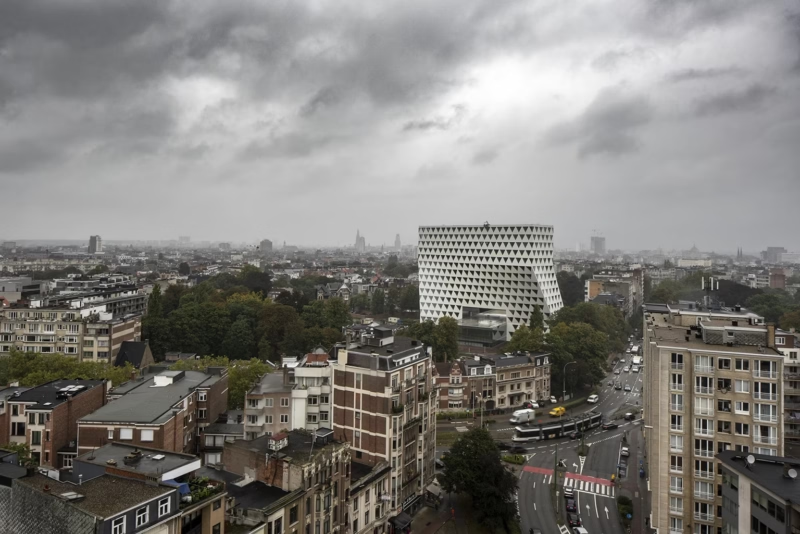
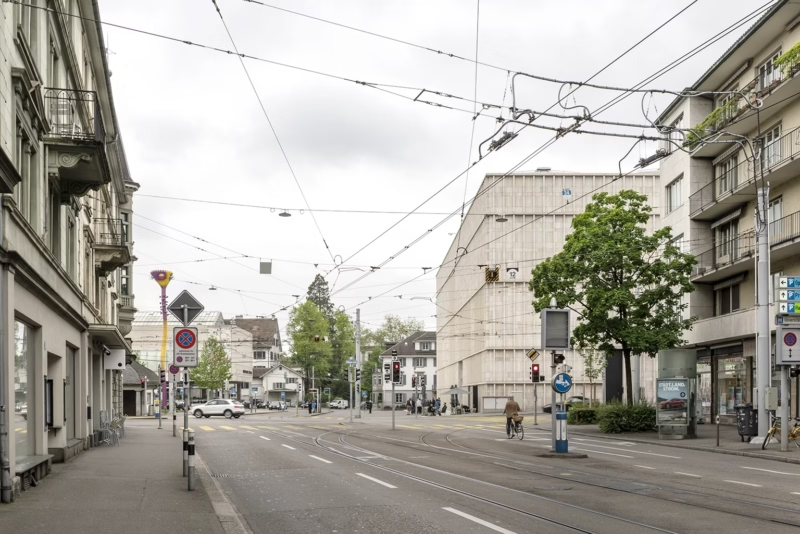
Two examples from northern Europe in more loaded contexts come from the British practice Caruso St John. The first, in Bremen — a city in northern Germany — responds to the iconographic need for a bank within a heritage setting next to the medieval town hall and the cathedral. Following the great tradition of this part of the old continent, they propose facades of dark clinker brick shaping pinnacles and buttresses with a marked Gothic and monolithic character. The doorway symbolically heightens the entry to the institution, resolved with a succession of arches and a change of brick colour inside. The curvature of the facade segments softens what would otherwise be a rigid composition. More on the project at the Bremer Landesbank project page.
Newport Street Gallery — Caruso St John
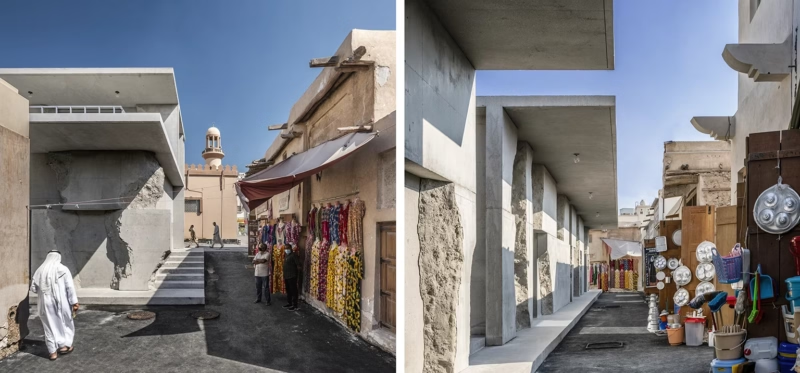
The second example by the same studio takes place inside a gallery they renovated in London from existing industrial sheds. The exterior presence of the project is given; however, inside, the gallery unfolds across two levels, and it is in the spiral staircases connecting these two floors that brick transforms the patent roughness of the industrial setting into something else. The curved white ceramic-block walls surrounding the staircases — capped by skylights — turn them into perfect resting places during the visit. Moreover, the contrast between a marked urban-industrial character outside and the domestic feel of these interior spaces makes them very comfortable transitions.
Clos Pachem winery in Gratallops — Harquitectes
A final example of how the use of ceramics solves more contemporary problems while generating traditionally classical spaces comes from the Catalan studio Harquitectes. As they have stated regarding brick, what concerns them is not so much the material as its behaviour. This is the contemporary part of their thinking: tuning into social demands through energy concerns, cost containment and maintenance, all of which brick allows them to deliver.
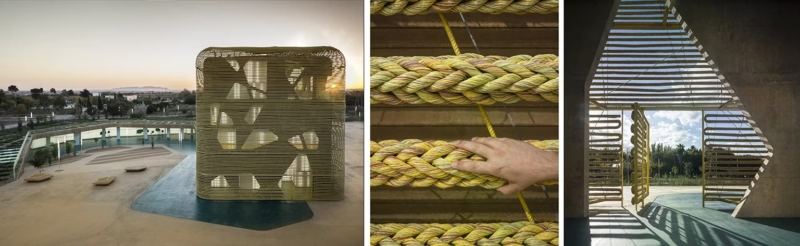
In Gratallops, a small town in El Priorat, a winegrower client commissioned them to design a winery on an urban plot. They propose a building capable of contributing to a winemaking process based on biodynamic principles, working through passive systems or as little artificial intervention as possible. The main space is a triple height composed of terraces. The principal volume is surrounded by very thick walls built with a load-bearing system of multiple layers and air-circulation chambers that cool the building. Another brilliant contribution of this project is the roof, which — through a closed-loop water recirculation system — becomes a large-scale temperature exchanger between the interior of the hall and the outside. More on the project at the Clos Pachem project page.
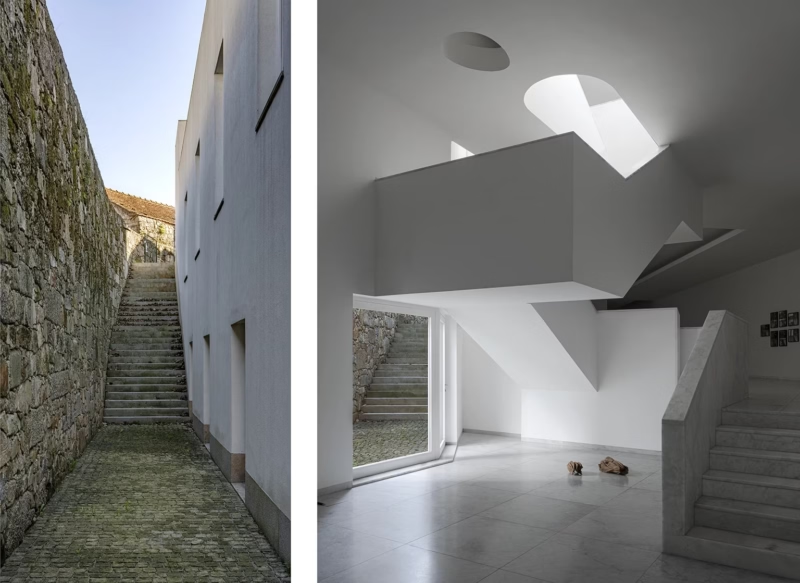
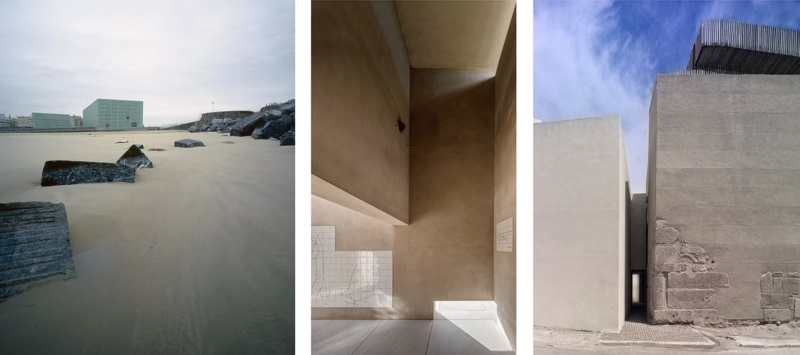
In conclusion, all these projects share the use of a traditional construction element used in very diverse ways, responding to economic, aesthetic, technological, constructive, heritage and social conditions. I am aware that my photographs must limit themselves to illustrating these complex ideas that ceramic constructive solutions generate, but brick is undoubtedly one of the materials that best embodies spatial comfort in an image. So too the vernacular particularities of each place where it is built, since it still depends on a certain craft tradition to be executed.
The paradigm shift humanity faces in relation to the growing carbon footprint that mortgages our future calls for these kinds of contributions and solutions. The architect’s wit and the proper use of tradition and architectural knowledge will do the rest. Meanwhile, I will go on bearing witness to all those wonderful, comfortable spaces that ceramics and good architectural projects offer us.